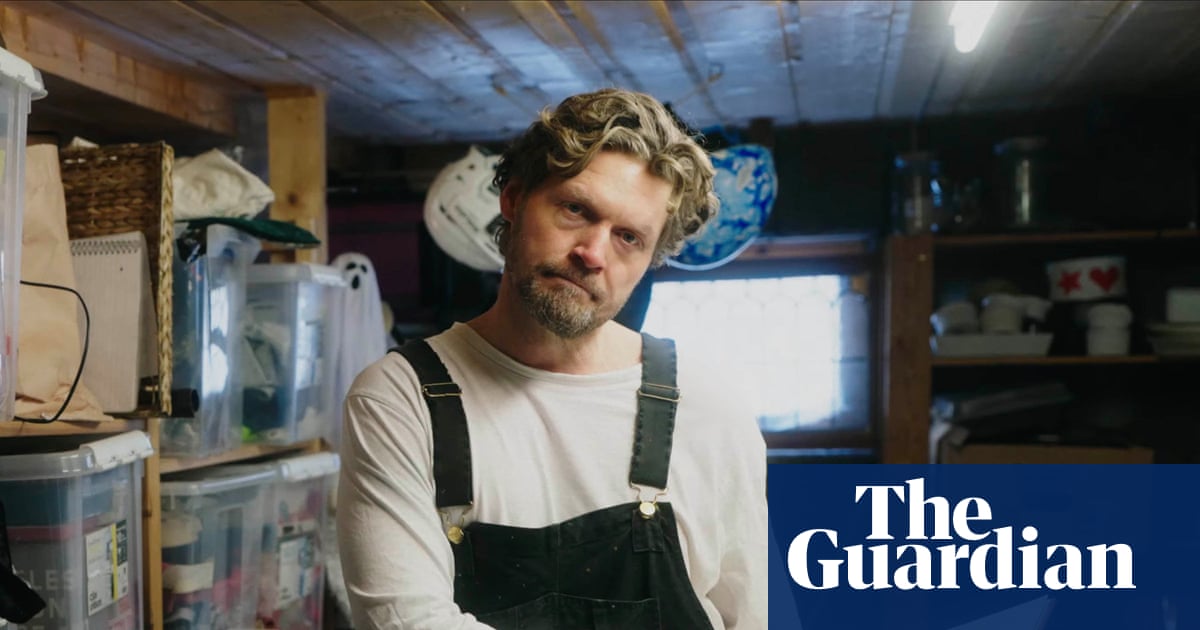
The video’s opening shot shows a man hiding under a bed snipping in a hole in someone’s sock. Seconds later, the same man uses a saw to shorten a table leg so that it wobbles during breakfast. “My job is to make things shitty,” the man explains. “The official title is enshittificator. What I do is I take things that are perfectly fine and I make them worse.”
The video, released recently by the Norwegian Consumer Council, is an absurdist take on a serious issue; it is part of a wider, global campaign aimed at fighting back against the “enshittification”, or gradual deterioration, of digital products and services.
“We wanted to show that you wouldn’t accept this in the analogue world,” said Finn Lützow-Holm Myrstad, the council’s director of digital policy. “But this is happening every day in our digital products and services, and we really think it doesn’t need to be that way.”
Coined by author Cory Doctorow, the term enshittification refers to the deliberate degradation of a service or product, particularly in the digital sphere. Examples abound, from social media feeds that have gradually become littered with adverts and scams to software updates that leave phones lagging and chatbots that supplant customer service agents.
Here’s the video, it’s funny cause it’s infuriatingly true.
Genius
the term enshittification refers to the deliberate degradation of a service or product, particularly in the digital sphere
That’s not exactly what it is, though. Enshittification is the deliberate degradation of a product for the purpose of extracting maximum revenue, where the product is progressively degraded up to the point where the consumer ditches it, but not exactly to it.
Without the tie to maximum revenue and measurement of consumer ability to cope, it’s hard to understand why enshittification is so brutally frustrating.
Feels very fitting for The Guardian to downplay how the profit motive inherent in capitalism contributes to enshittification, even when Doctorow’s original definition clearly includes it.
The “for the purpose of extracting maximum revenue” is a bit redundant, though.
Everything a corporation does is for that purpose.
Cory Doctorow describes the stages of enshittification as follows:
It’s a three stage process: First, platforms are good to their users; then they abuse their users to make things better for their business customers; finally, they abuse those business customers to claw back all the value for themselves. Then, they die.
And for good measure he reminds us of the why and how things used to be better:
The pre-enshittification era wasn’t a time of better leadership. The executives weren’t better. They were constrained. Their worst impulses were checked by competition, regulation, self-help and worker power.
https://doctorow.medium.com/my-mcluhan-lecture-on-enshittification-ea343342b9bc
You know, I agree with him that the pre-enshittification era wasn’t a time of better leadership, but I don’t think he got the reason for the change right. I think what we call Late Stage Capitalism comes from a single source: corporations don’t give a rat’s ass any longer if they exist in ten years. They are willing to toss reputation and long-term prospects out the window because the only metric that matters is quarterly numbers.
It’s a thing I noticed on the Internet. I wondered why so many sites become big and then shoot themselves in the foot. We are on Lemmy (well, I am on Piefed) now, many of us from enshittified Reddit. But Reddit was the savior from an enshittified Digg, which was the savior from an enshittified Slashdot, etc. It figures that each iteration knew they were going to die making the choice they made, but also knew the quarter would be spectacular.
That worries me, because it’s much easier to destroy something than to build it. If you go and look, the Internet is slowing down. It isn’t being innovated, despite the need to do so. Instead, the big players see something grow, and they use their massive resources to buy it and kill it.
That’s why I love open source: what is being built has long term plans. The main way that open source projects get enshittified is when they close source innovation and then follow the same trajectory as the big companies.
I think you’re being overly optimistic about the dying part. Folks here are not exactly a random sample - even if many people see the enshittification of Facebook or Reddit, they will feel unable to leave. Especially for social media there’s a huge network effect - the value of the product is in the fact that “everyone” is there. Or for Google products: there are just so many different problems for the user to solve (if there’s a current solution at all!) before being able to move. So yes, the focusing on quarterly profits extracts value at the cost of everyone else, but it might not be enough to kill the product. Or at least not for quite a long time. For me the root of the problem is that we gave up on countering monopolies. This has always been a grave enemy of “efficient” capitalism, but over the last few decades we kind of stopped efforts to prevent this. It automatically leads to worse service for any client, not just in the digital sector. Worse, it leass to concentration of power in such few hands that any political system shifts into an oligarchy.
Was there a “pre-enshittifcation era” or were we merely at the first stage of system-wide enshitification?
The late 90’s, early 00’s were pre-. About 2003-05 it started becoming enshittified, ie: ISPs started throttling, a lot of forums were bought out and/or priced out, etc.
Actually, I think that’s the main process of enshittification, but I don’t think enshittification is always deliberate.
Very often software products are tweaked, changed, or even degraded in an attempt to “simplify” or “improve” a particular user experience at the expense of another UX.
And to make matters worse, some companies end up with a Frankenstein product of confusing functions because they are trying to cater to two entirely different user bases within the same product.
E.g. Microsoft may genuinely have believed that changing their system settings UI in Windows 11 to “consolidate and reduce drift” of system configurations would improve the everyday user experience, but they failed to account for the decades of inertia they’d built up from their prior OS user base and how that would piss off a not-insignificant number of other users who had grown accustomed to the way the product had previously worked.
As they say. The cloud is someone else’s computer.
Emphasis on someone else
Irrelevant. They can do it to devices you physically own.
Only if it is linked to an online service or update service. In the absence of that they need to hard bake their enshitification strategy upfront.
The problem is capitalism. Specifically, the consolidation of power in a small number of decision makers.
Break up the big companies. Stop letting them do mergers and acquisitions. You don’t even have to do something radical like dismantling capitalism entirely.
I wish I knew how!
Dismantle the establishment board by board
I guess we just keep voting Democrat until something happens…
Oh my sweet summer child. How have the jailors convinced you that half of them are on your side and it’s just the other jailors that are keeping you here?
The more a party wins, the more the Overton window shifts in its favor.
If Democrats win enough times, Republicans will have to push less radical ideas to get a chance at being elected.
And if Republicans aren’t as much of a threat, Democrats will have to come up with an actual platform that isn’t just “we’re not Republicans”.
You can see the difference in Democrat Presidents from before and after the three consecutive R terms of 80-92, and how Middle-of-the-road the following ones have been. Which allowed Republicans to get more extreme.
We just need to make that happen in reverse.
By the same logic, the more either party wins, the more the Overton window stays fixed on the current systemic status quo being the only viable, or even imaginable system.
Both parties are unambiguously serving the interests of their respective elites. They’re just using different tactics to distract their respective audiences. In both cases the core strategy is to evoke the strong emotional intuition that sacred values are being violated. For conservatives, those values are tradition, and especially sexual norms. For liberals, it’s the protection of vivid victims.
The only actual solution is to stop fighting your enemies and start working together to actually redistribute power and reform the whole system.
Oh, worth putting out there, the other tactic I see often is to create the impression that the only alternatives are 19th century political philosophies: capitalism vs communism, etc. In reality, there is a massive space of potential global political and economic systems we could adopt, and we’re in a much better position to work together as a single species to scientifically explore that space and design a stable global system than we were 150 years ago. But we can’t get started while everyone is convinced that all they can do is vote for their team in the next election.
By the same logic, the more either party wins, the more the Overton window stays fixed on the current systemic status quo being the only viable, or even imaginable system.
Then by that logic, how do you explain Republicans going more and more off the deep end after they kept on winning? The system isn’t “fixed on the status quo”, it’s actively getting worse.
Both parties serve elites, that’s true. But they can only afford to do that because one party promotes Christofascism and half the country joyfully votes for them, so the other can basically do nothing and still be the better choice for a sane person.
There’s a lot that we could theoretically do to change the system, but is that possible when the majority of people in voting age are forced to have a stable job to survive and mass media does everything they can to push narratives in the few spare time they might have to get informed? I’d love if everyone could afford to organize general strikes to, for example, put in place an actually functional voting system instead of FPTP, but that’s just not a likely outcome and probably won’t be in our lifetimes.
Let me be clear, I’m not saying all we can do is vote for “our team”. But we NEED to keep doing that, at minimum. Then, if you can afford it, you can also organize to push for reforms, protest, strikes and everything else. But if we keep on letting fascists take office because “the other side was better, but still bad so I didn’t vote them”, soon it’ll even be illegal to do anything else.
To your opening question: in two dimensions, you can stay still in one while moving along the other.
We’re in a complex multidimensional space of political/economic possibilities, but the current discourse keeps everything focused on a single left/right dimension as though that’s all that matters. By ensuring you’re only seeing that battle, always fighting the other half of the population, they prevent any possibility of change in other directions (e.g., massive capital market reform/redistribution).
I’m not American so can’t speak to your detailed points about Republicans, but the same left/right, liberal/conservative division is happening everywhere, as well as the simultaneous acceleration of the polarisation of wealth, erosion of wealth redistribution systems and rapid destruction of our global environment for the short term gain of the ultra wealthy.
Insisting that you must constantly fight the other half of your country’s population is an error. You are being distracted and misled. So are they. You don’t win by beating them. You win by convincing them to stop fighting too.
The problem is that pretty much everything economic still moves on a left/right axis. Capital market reform/redistribution is a left-wing concept, and polarization of wealth, or lack of market regulation, is a right-wing one.
Then at present time there’s a lot of other concepts that have been stapled onto the simple economic axis to further divide the population, such as culture war, religion, discrimination and whatnot, but even if you remove all of that, there’s the fact that a lot of people simply don’t want wealth redistribution. The infamous “temporarily embarrassed billionaires”, as they’re often called. You can’t convince them to “stop fighting” if the very thing you want to achieve is the same one they’re fighting against.
The only way to convince them is to straight-up depropagandize them, to make them realize that the “American Dream” is bullshit, that they’re never going to magically become a billionaire and benefit from all the stuff they’re fighting for, and that wealth redistribution would benefit pretty much everyone on the planet. But there’s people that have tried and failed to do so with their own family, how possible is that to successfully do for the whole country? Especially when every form of information, whether it’s mass media or social networks, work to convince them of the opposite?
Not sure I agree with the statement that we wouldnt accept enshittification in our analog lives… ovens and refrigerators with screens and becoming unrepairable, cars are only sold with onboard computers and power windows with no other price point, materials for most household items becoming plastic / single use / or deliberately designed with a failure lifetime. I recently started buying clothing with no synthetics and they are unfathomably better performing in terms of breathing, odor, comfort and warmth. We’ve forgotten what physical products used to be like, in 20 years we will have similarly forgotten what un-enshittified internet / tech was like.
I think, and perhaps it’s scarier than anyone wants to admit, we’ve already gotten accustomed to or given up fighting against enshittification of the analog world.
The common thread is capital and financialization, and there can be never be progress until the ideas in “how to win friends and influence people” are called out as demonic and unhuman.
The fact that half of eligble voters in the US willingly voted for the ultimate enshittifier not once, but twice, is a testament to this.
The problem here is - in my opinion - caused by:
- the need to chase unlimited growth (by definition impossible)
- lacking regulations
- monopolies and such
- price fixing
- weak worker rights
The right always chasing “deregulation”? Well, here is the result. High profits, high prices, shitty products and services.
And the people suffer.
Also the mental disease which is known as “wanting to be a billionaire”. Everything in the world is structured around making that status the ultimate goal. It is like endorsing sociopathy.
With Elon Musk soon to be a trillionaire and maybe Zuckerberg and Bezos, too. Being a billionaire won’t be the dream goal anymore.
i dream of being out of debt
For me it’s a tale about loss of ownership in a dematerialised world. No one is going to cut a piece of my dining table because I own it and physically have it entirely at my side.
I’ll never own (my locally installed) Spotify nor the songs I listen to. Though for the later I have vinyl alternatives which no one is touching.
can’t beat physical media
Yeah but I’m not putting my turn table in my back pack to go fishing with ;-)
There’s always the in between “ipod-era” setup, which is what I’m trying to transition back to: ripping and collecting media locally, then listening to it on my phone without streaming.
Ha yeah the times of my creatives « something ». It was so easy to manage. Less convenient than Spotify but that was super nice. Though it’s bound that there a plex equivalent for audio that I could look into. Family sharing is one of the functions I would miss going back to the dedicated player.
I use Jellyfin for simplicity, which probably isn’t the most preferred service for music, but it doesn’t really matter if you’re accessing it from your choice of mobile app anyway. You can set it up to stream your music library to your phone anywhere if you want also. (Android Auto even has an app)
I’m not confident enough to open up my media server to the outside world yet because I’m still a noob at this stuff, so I just have my full library when I’m at home and anything I’ve downloaded to my phone while I’m out.
You can even set up family sharing - you just give them a login, and they have access to all the same music.
On the open to the outside world I bypassed the issue by only allowing vpn into the local network and the particular subnet allowed to vpn users is itself limited to specific resources on our internal network. Removes a lot of headaches but in general I don’t go for the hassle to setup the vpn accounts for rando / acquaintances.
I looked into jellyfin but my first attempt was not the success I hoped it would be hence why I use plex for videos.
Smart idea to use such a solution for audio but it likely comes with limited playlists features and no lyrics ?
If you want a specific variety of a plant that’s patented by, say, Monsanto, you don’t own the seeds you get but rather their permission to plant them.
If you re-plant seeds in your own field produced by the crops of the previous year on that same field they can sue you and they will win (see Bowman v. Monsanto Co.)
They’ll also sue your neighbour if your plants spread seeds to their land.
This is why I only seed torrents
That’s cool. Good thing I have a black light, and can modify the seeds the same way they do. Therefore, not the same seeds.
Edit: didn’t make this clear enough, the idea is to lightly modify their seeds just enough to make it legal. If they want to be shitty, we can be shitty right back. Any rule they make for us they make exceptions for the rich. Therefore, with enough cleverness and a stubborn refusal to accept others bullshit(and a bit of spite) you can exploit their rules and bend them to your will.
In his Enshittification book, Cory referred to this as “technofeudalism” —essentially the return to the feudal society where there are owner elites and peasant subjects. The owners control everything, and the peasant have to rent access under the terms and conditions set by the owners. In the technofeudalism model, everybody (the peasants) have to subscribe to access anything from the corporations (the owner elites), with the corporations retaining all the power.
You can have digital no problem. I have 25 year old mp3s. It just needs to be physically on your drives. You can pirate or purchase music today without issues. Spotify just scratched that laziness itch at one point in time and now you are locked in.
A few days ago I tried to find the best frame of the video to turn into a meme. This is what I came up with.

This is a handy meme to have these days. I hope to see it in circulation and to spread it myself! Thanks!
I’m happy with the updoots that I got. I’d be even happier if I see someone else use it in a comment thread.
As long as companies primary purpose is to make value for the shareholders, this will continue. It is a race to the bottom.
How do you fix that without massive upheaval for the people you are trying to help. I don’t know.
Companies used to have a smaller reach, meaning less total and potential customers. So they had to balance what what was good for the shareholders qith what was good for the customers or risk losing both. But products are often global now, especially digital ones. There seems to always be more customers to replace the ones they lose. And investors don’t care as much about the long term since they can trade stocks so quickly. Maybe the solution is required holding periods for stocks or something. Higher short term capital gains taxes, and better incentives for long term gains.It can change, but it’ll require a large number of people seeing it as a problem worth addressing. Companies currently don’t value customer experience very well and haven’t for a long time, witness how phone customer service has become loaded with automated services standing between users and a small phone support staff. But if that were change, if stockholders were to come to see how much users hate that, and more importantly if users were to base their habits on that decision, it might cause things to improve. Money people, despite their near-legendary density, tend to be very nervous about trends. It might be possible to spook them.
Well, I think it could happen. I’ve been wrong before.
It’s tough, the companies can’t change unless the people do. Meaning customers refusing to do business with companies that have bad customer service or refusing to buy stocks in such companies. But there will always be people who see that they can make money off of other people doing that. And it doesn’t work if some people get rich bucking the trend.
Companies very well can change. Nothing forces them to enshittify their customer service for what amounts to virtual pennies per user. It’s entirely a case of narrative capture among business people, the conventional wisdom that they have to do this stupid thing. That’s it.
Unfortunately, that just isn’t true. The board of directors have a legal fiduciary responsibility to the share holders. And they hire or fire the ceo. If they don’t chase that virtual pennies, the shareholder can, and do sue them.
And as I said, if they don’t do things that at least make it appear they are attempting to increase profits, shareholder will sell, and they will go out of business.
It’s a race to the bottom. And the system is to blame. The system has rewarded people who enshitify products, and thus it has shapped who gets hired to make those decisions.
It’s because those shareholders are captive to that same narrative. These practices do carry a real cost, but executives have made themselves blind to it. There are people who’s job it is to judge the value of customer satisfaction and loyalty and to measure it against the cost of providing good service, and they think the former is less valuable than the latter. My premise is these people are not doing their job well.
This view of the purpose of a company, to ruthlessly extract every cent of value from a company or else face the wrath of shareholders, it’s a fairly recent view. Shareholders selling doesn’t cause a company to go out of business, failing at that business does. Stock price falling is a different issue, it matters because company success has come to mean the success of its shares more than the amount of customer goodwill. But that matters.
I sense though that we really aren’t on different sides. I wouldn’t say you’re absolutely wrong, nor that I’m absolutely right. We both have profound dissatisfaction with this world that all these rapacious companies have build around us. The next generation of business people, if we’re privileged to even have one, will have to figure out some things for themselves all over again.
I do agree we seem to be on the same side.
Semantics is a bit of a passion of mine. The question I think we differ on the answer to, is wnat is an executives job. I wish it was what you appear to believe. But at the nd of the day, they are there to make money. And helping the stock price makes money for the people above them, who in turn will ensure they are employed in the future. Including at a different company.And true, a falling stock price does not but a company put of business, that was a poor choice of words. It causes it to get bought by someone else, and either disolved or absorbed. So I guess maybe extinct is a better word. It certainly is more fun.
Please consider: it at executive’s job is only to make money, then why would any executive do anything but chase the single most source of maximum profit, which right now is obviously scamming people and courting Trump’s favor to get out of consequences? Who would care about building anything real? How could they? Just chase hollow bets and game the system as far as you can?
You can complain about capitalism, and indeed there are many problems with it, but I think you should realize that today’s hyper rapacious version of it is not historical, it’s a fairly recent interpretation of the law. A company is more, MUST be more than a single minded profit making engine. If it always had been, our civilization would have collapsed long before now.