

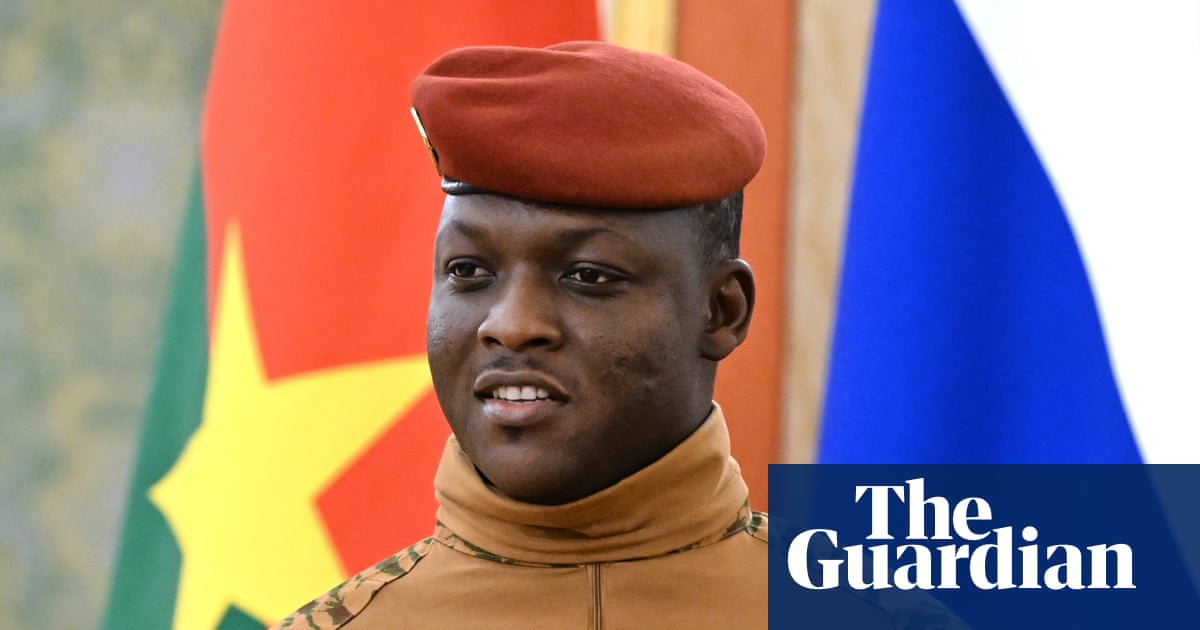
Ibrahim Traoré, who took power in 2022 coup, tells state broadcaster ‘we must tell the truth, democracy isn’t for us’
People in Burkina Faso should forget about democracy as it is “not for us”, the military president, Ibrahim Traoré, told the country’s state broadcaster.
Traoré took power in a coup in September 2022, toppling another junta that had taken power just nine months earlier. He has since stifled opposition and in January banned political parties outright.
A transition to democracy had originally been planned for 2024, but that year the junta extended Traoré’s rule until 2029.
“We’re not even talking about elections, first of all … People need to forget about the question of democracy … We must tell the truth, democracy isn’t for us,” Traoré said in an interview on Thursday with the state broadcaster Radiodiffusion Télévision du Burkina (RTB).
To put it simply, when western forces colonize a people, they simultaneously suppress and frame their traditions as barbaric and prop up their own western values as civilized. The colonized people experience unconscionable violence from these western forces, seeing first hand the inhumanity being caused in the name of ‘civility’. Naturally, as anti-colonial resistance mounts, the most anti-West voices gain the most momentum, seen as less corruptible to those western forces and more unwavering in their resistance. So it’s no surprise that reactionary attitudes on civil rights come as a reaction to western colonialism.
It’s only once a people are able to reclaim their sovereignty that civil rights movements are able to build, fight for, and win those rights domestically. Without being co-opted by foreign powers with the only goal of destabilization.
I wasn’t aware of the connection myself until I read Fanon’s works at length
No doubt it and many other historical events will affect many things later on but it’s still not really a reasonable position to assume that has to be it even with lots of evidence that makes it seem unlikely in a particular case. Colonialism did not introduce anti-homosexual attitudes to the African continent. Islam, which arrived before the western colonialists also has them but wasn’t the first appearance of that there either.